
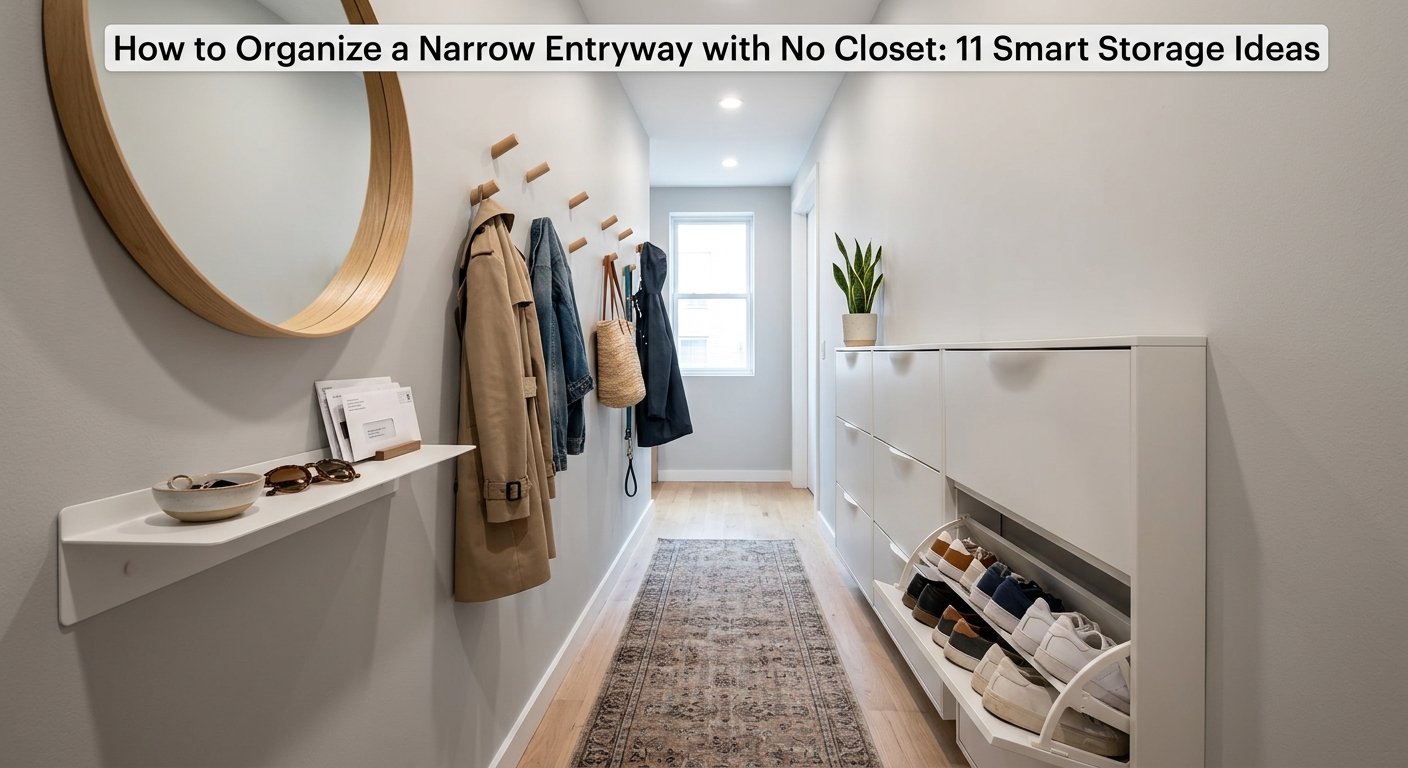
Walking into a cluttered, narrow front entrance after a long day at work immediately creates unnecessary stress. Coats are tossed over dining chairs, shoes pile up near the front door, and mail gathers endlessly on the nearest counter. If your home or rental apartment lacks a dedicated front coat closet, managing daily entryway clutter can feel nearly impossible.
The good news? You do not need a spacious mudroom or a deep built-in closet to create a functional, stylish, and welcoming entrance. By shifting your focus from floor space to vertical storage, utilizing slim-profile furniture, and establishing clear drop zones, you can transform even the tightest hallway into a highly organized space.
In this comprehensive guide, we will break down the essential rules of hallway spatial planning and share 11 actionable, renter-friendly storage ideas to help you master how to organize a narrow entryway with no closet.
(Insert Image 1 Here – Alt Text: modern narrow entryway design with floating table and wall hooks no closet)
The 3-Zone Rule for Small Entryway Planning
Before purchasing organizers or drilling hooks into your walls, it is critical to understand how people naturally move through an entrance. Every functional entryway—regardless of size—requires three distinct operational zones:
Zone 1: The Instant Drop Zone
This area should be located closest to the door handle. It serves as the immediate landing spot for items you pull out of your pockets the moment you step inside.
-
Primary Items: Keys, mail, sunglasses, wallet, lip balm, and hand sanitizer.
-
Best Solutions: Small wall-mounted key bowls, floating ledges, or narrow drawer units.
Zone 2: The Hanging & Outerwear Zone
This zone replaces the traditional coat closet by taking advantage of open wall space.
-
Primary Items: Everyday jackets, work bags, umbrellas, dog leashes, and scarves.
-
Best Solutions: Heavy-duty wall pegs, pegboards, and vertical hook rails.
Zone 3: The Footwear & Traffic Zone
The floor area near the entrance needs to stay entirely clear of foot-tripping obstacles to maintain proper home safety and airflow.
-
Primary Items: Daily shoes, boots, and slippers.
-
Best Solutions: Ultra-slim shoe cabinets, under-bench baskets, or low-profile boot trays.
(Insert Image 2 Here – Alt Text: staggered wooden wall pegs with coats and bags in small entryway)
11 Practical Ways to Organize a Narrow Entryway Without a Closet
1. Install High and Low Wall-Mounted Pegs
When horizontal floor space is limited, vertical wall space is your strongest asset. Instead of relying on a bulky, freestanding coat rack that takes up valuable floor real estate and tips over easily, install a continuous row of wall pegs or a wooden hook strip.
Pro Tip: Stagger your wall hooks at two different heights. Place upper hooks at eye level (around 60 to 65 inches) for adult coats and long bags. Install lower hooks (around 36 inches) for kids’ backpacks, dog leashes, or umbrellas. This simple layout adjustment doubles your hanging capacity without increasing the footprint.
2. Choose an Ultra-Slim Floating Console Table
Standard console tables are often 14 to 18 inches deep, which will completely choke a narrow hallway. Look specifically for floating console tables or ledge shelves with a depth between 6 to 10 inches.
Because a floating console attaches directly to the wall studs without legs touching the floor, it creates an open visual line underneath. This tricks the eye into perceiving the hallway as wider while giving you a surface for your keys, mail, and decorative accents.
3. Utilize Slim Depth Shoe Cabinets (IKEA Trones Style)
Shoe piles are the single largest contributor to entryway clutter. Traditional shoe racks leave shoes exposed and protrude too far into walking paths.
Tilting shoe cabinets—such as the popular IKEA Trones or Bissa series—are specifically engineered for tight spaces. They are typically less than 7 inches deep because shoes store vertically inside downward-flipping compartments.
-
Bonus Hack: Mount two or three shoe cabinets vertically on top of one another to build an integrated wall unit, or arrange them side-by-side to create a long, shallow sideboard topped with a continuous wooden plank.
(Insert Image 3 Here – Alt Text: slim wall mounted tilt out shoe storage cabinet for narrow entryway)
4. Hang an Oversized Wall Mirror Above the Drop Zone
Mirrors are an interior designer’s secret weapon for cramped layout solutions. Hanging a large round or arched mirror above your entryway shelf serves two major functions:
-
Light Reflection: It bounces ambient light from adjacent rooms down a dim, windowless hallway, making the area feel bright and airy.
-
Functional Check: It allows you to perform a quick appearance check right before walking out the front door.
Opt for a mirror frame that matches your hardware accents (matte black, brushed brass, or light natural oak) to keep the decor clean and purposeful.
5. Utilize Over-the-Door Hanging Systems (Best for Renters)
If your lease agreement strictly prohibits drilling into drywall, leverage the back of your front door or adjacent room doors.
Modern over-the-door organizers have evolved far beyond cheap clear plastic shoe sleeves. Look for heavy-duty metal over-the-door racks featuring matte black finishes, canvas storage pockets, or built-in wooden pegs. These systems allow you to store light jackets, scarves, umbrellas, and hats without making a single nail hole.
6. Add a Narrow Storage Bench with Hidden Compartments
If your hallway width allows for at least 12 to 14 inches of clearance, a low-profile storage bench adds both function and comfort. Being able to sit down while putting on or taking off shoes is a major luxury in small spaces.
Select a bench model with a lift-top lid or open lower cubbies where you can slide woven storage baskets. Use the hidden internal space for off-season gear, such as winter gloves and beanies during summer, or beach towels and sun hats during winter.
7. Install a Modular Pegboard System
Pegboards are no longer reserved just for garages and workshops. Sleek birch plywood or metal pegboards have become a major trend in Scandinavian and modern minimalist interior design.
A wall-mounted pegboard offers total flexibility:
-
Move wooden pegs around whenever coat lengths change.
-
Add small clip-on wooden shelves for sunglasses or small potted succulents.
-
Attach mail clips and key hooks wherever needed.
Because the components are fully adjustable, a pegboard easily adapts as your daily carrying needs change throughout the seasons.
(Insert Image 4 Here – Alt Text: modular wooden pegboard entryway organizer with hooks and shelves)
8. Use Wall-Mounted Vertical Mail Holders
Loose mail, bills, and flyers are infamous for creating visual chaos on flat surfaces. Eliminate flat-surface counter clutter entirely by mounting a multi-tier vertical wire or wooden mail sorter next to your front door.
Assign specific slots for incoming mail, outgoing letters, and important household documents. Sorting mail the second you walk through the door prevents important papers from getting lost under keys and jackets.
9. Take Advantage of Dead Corner Space
Look closely at your entrance doorway. Is there an unused 90-degree corner right behind the door swing? Corners are frequently overlooked in small space design.
Install floating corner shelves or a tall, slim corner coat tree. Utilizing corner real estate frees up the main hallway corridor while providing dedicated storage for items like umbrellas, tall boots, or bike helmets.
10. Hide Clutter in Matching Woven Baskets
Open storage (like open shelves or shoe racks) can quickly look visually overwhelming if items are not meticulously arranged.
Baskets are the ultimate tool for streamlining open storage. Measure your shelves or under-bench spaces precisely and buy matching natural sea grass, rattan, or felt storage bins. Group similar items inside separate labeled baskets:
-
Basket A: Dog accessories (leashes, waste bags, dog jackets).
-
Basket B: Winter accessories (scarves, beanies, thermal gloves).
-
Basket C: Footwear care (shoe polish, extra laces, lint rollers).
11. Define the Space with a Machine-Washable Runner Rug
A long, narrow runner rug does more than protect your hardwood or tile floors from outside dirt—it visually defines the entryway as its own distinct “room,” even in an open-concept apartment layout.
Choose a low-pile, machine-washable runner rug with a non-slip rubber backing. Low-pile fabrics ensure your front door swings open and closed smoothly without catching on the rug edges, while washability ensures easy cleanup after rainy or snowy weather.
(Insert Image 5 Here – Alt Text: low pile machine washable runner rug in narrow entryway hallway)
Comparison: Top Narrow Entryway Storage Options
To help you decide which storage solutions best fit your hallway dimensions and living situation, use this quick comparison reference:
| Storage Type | Depth Needed | Best Used For | Renter Friendly? | Visual Impact |
| Slim Tilt-Out Shoe Cabinet | 6″ – 7″ | Daily footwear, small umbrellas | Yes (Anchor with removable strips or minimal screws) | Clean & Streamlined |
| Floating Wall Ledge | 4″ – 8″ | Keys, mail, small decor | Yes | Minimalist & Open |
| Modular Wooden Pegboard | 2″ – 4″ | Jackets, hats, tote bags | Medium (Requires drywall anchors) | Modern & Stylish |
| Over-the-Door Hook Rail | 3″ – 5″ | Lightweight coats, bags, scarves | 100% Yes (Zero drilling required) | Functional |
| Under-Bench Storage Baskets | 12″ – 16″ | Seasonal gear, bulky items | 100% Yes | Cozy & Textured |
Frequently Asked Questions (FAQs)
Q1: How do I organize a narrow entryway if I am renting and cannot drill holes?
Focus on zero-damage hanging hardware and non-permanent furniture. Use heavy-duty adhesive wall hooks (rated for up to 15 lbs) for hanging coats and keys. Rely on over-the-door organizers for outer layers, and use freestanding, ultra-slim console tables or shoe benches that sit flush against the wall without requiring permanent wall anchors.
Q2: What is the minimum hallway width needed to keep an entryway walkable?
Building codes and interior design standards generally recommend maintaining a minimum clear walking path of 36 inches (3 feet) in main hallways. If your hallway is only 42 inches wide, your furniture depth should not exceed 6 inches to keep movement comfortable and unobstructed.
Q3: How do you make a dark, narrow entryway look bigger and brighter?
Stick to light wall paint colors (such as soft off-white, warm beige, or light gray) with a satin or semi-gloss finish that bounces light. Mount a large mirror opposite an open doorway or window, and install slim overhead flush-mount LED lighting or plug-in wall sconces to eliminate dark corners.
Conclusion
Lacking a formal coat closet does not mean you have to accept a messy, disorganized entrance. By shifting your approach toward vertical wall storage, choosing shallow-depth furniture engineered for small spaces, and designating a simple drop zone for daily essentials, you can maintain a clean and welcoming entryway every day.
Start small: pick one area near your front door today—such as installing a row of wall hooks or setting down a mail tray—and build out your ideal entryway system step by step!