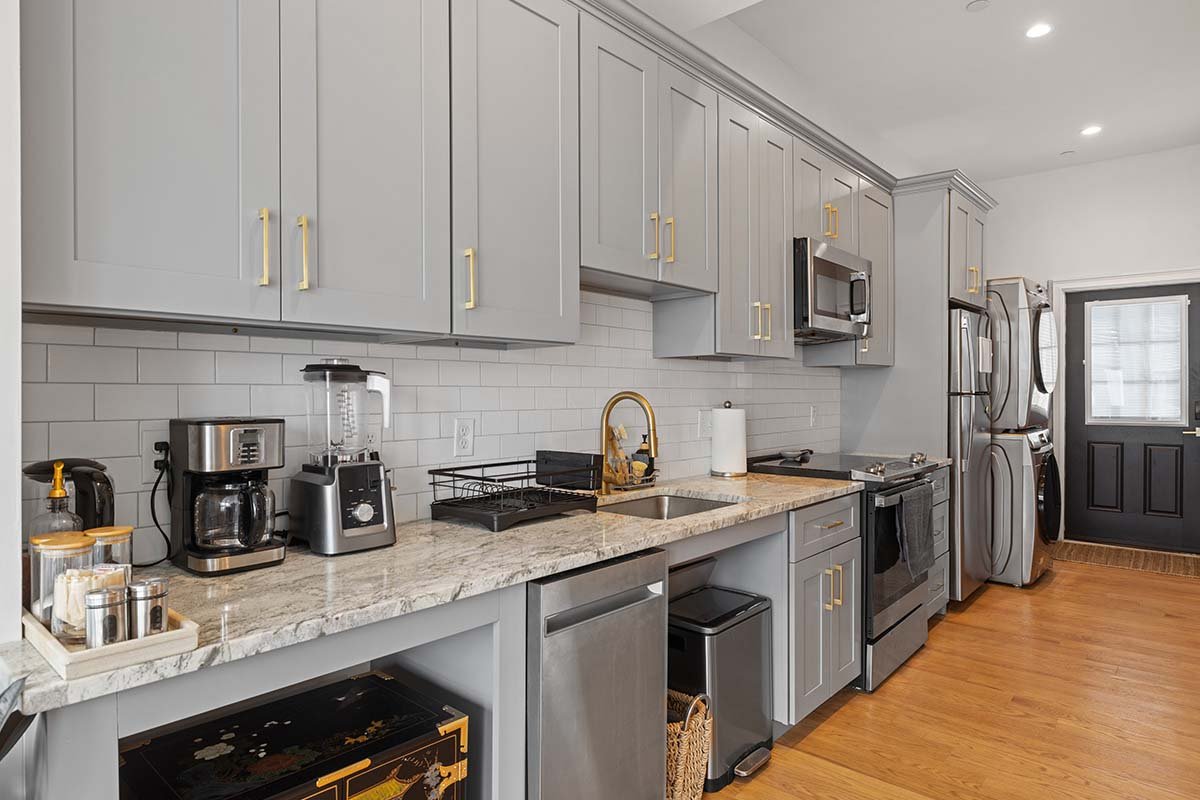
Kitchen cabinets are an important part of every functional kitchen. They provide storage, support countertops, organize cooking supplies, and contribute to the overall appearance of the room.
Although cabinets may look like simple storage units, they contain several different parts. Each component has a specific purpose, from the cabinet box and shelves to the hinges, drawer slides, handles, and decorative trim.
Understanding the parts of kitchen cabinets can help you choose new cabinets, repair existing ones, plan a kitchen renovation, or improve your kitchen organization.
What Are Kitchen Cabinets?
Kitchen cabinets are built-in or freestanding storage units designed to hold dishes, cookware, food, appliances, cleaning products, and other kitchen essentials.
Most kitchen cabinets include a combination of:
- Cabinet boxes
- Doors
- Drawers
- Shelves
- Hinges
- Drawer slides
- Handles or knobs
- Toe kicks
- Countertops or work surfaces
The exact parts depend on the cabinet style, construction method, and intended use.
Main Parts of Kitchen Cabinets
1. Cabinet Box
The cabinet box is the main body or structure of the cabinet. It forms the interior storage space and supports other components.
A cabinet box usually includes:
- Side panels
- Top and bottom panels
- Back panel
- Interior space
- Mounting points
Cabinet boxes may be made from plywood, particleboard, medium-density fiberboard, or other engineered wood products. The material and construction quality can affect durability and moisture resistance.
2. Cabinet Doors
Cabinet doors cover the front of the cabinet and hide the stored items. They are also one of the most visible parts of a kitchen.
Common door styles include:
- Shaker doors
- Flat-panel doors
- Raised-panel doors
- Slab doors
- Glass-front doors
- Louvered doors
Choose a door style that matches your kitchen design. Flat doors often suit modern kitchens, while Shaker and raised-panel designs can work well in traditional or transitional spaces.
3. Cabinet Drawers
Drawers provide easy access to smaller kitchen items. They are useful for storing cutlery, utensils, food containers, towels, and cooking tools.
Common kitchen drawer types include:
- Shallow cutlery drawers
- Medium utensil drawers
- Deep pot drawers
- Pull-out pantry drawers
- Soft-close drawers
- Full-extension drawers
Deep drawers are particularly useful for heavy cookware because they can make pots and pans easier to reach.
4. Cabinet Shelves
Shelves create horizontal storage levels inside cabinets. They may be fixed or adjustable.
Adjustable shelves allow you to change the storage height for different items, such as:
- Plates
- Bowls
- Glasses
- Food containers
- Small appliances
- Cooking ingredients
For better organization, use shelf risers, baskets, or stackable organizers.
5. Cabinet Hinges
Hinges connect cabinet doors to the cabinet box and allow the doors to open and close.
Common hinge types include:
- Concealed hinges
- Butt hinges
- Overlay hinges
- Inset hinges
- Soft-close hinges
Soft-close hinges help reduce noise and prevent doors from slamming. When replacing hinges, check the door style, overlay, screw positions, and hinge opening angle.
6. Drawer Slides
Drawer slides support drawers and allow them to move in and out of the cabinet.
Popular drawer-slide types include:
- Side-mount slides
- Bottom-mount slides
- Undermount slides
- Ball-bearing slides
- Soft-close slides
- Full-extension slides
Full-extension slides allow the drawer to open farther, making items at the back easier to access.
7. Cabinet Handles and Knobs
Handles and knobs are used to open doors and drawers. They also add a decorative detail to the kitchen.
Common options include:
- Round knobs
- Bar pulls
- Cup pulls
- Edge pulls
- Finger pulls
- Recessed handles
Popular finishes include:
- Matte black
- Brushed nickel
- Chrome
- Brass
- Bronze
- Stainless steel
Choose hardware that is comfortable to grip and suits the rest of the kitchen fixtures.
8. Cabinet Face Frame
A face frame is the frame attached to the front of some cabinet boxes. It surrounds the doors and drawer openings and adds structural support.
Face-frame cabinets are common in traditional and transitional kitchen designs.
The frame may include:
- Vertical stiles
- Horizontal rails
- Door openings
- Drawer openings
Some modern cabinets use a frameless construction instead, which provides a more streamlined appearance and slightly more interior access.
9. Cabinet Stiles
Stiles are the vertical pieces of a cabinet face frame. They are usually positioned at the sides of the cabinet opening or between adjacent doors.
Stiles can provide:
- Structural support
- A place for hinges
- A finished front appearance
- Separation between cabinet doors
The width of the stiles depends on the cabinet design.
10. Cabinet Rails
Rails are the horizontal parts of a cabinet face frame. They may appear at the top, bottom, or between doors and drawers.
Rails help connect the vertical stiles and create a stable cabinet front.
In framed cabinet doors, rails can also refer to the horizontal pieces that form the door itself.
11. Cabinet Back Panel
The back panel closes the rear of the cabinet box. It helps keep stored items inside and can provide additional structural stability.
Back panels may be:
- Thin fiberboard
- Plywood
- Engineered wood
- A thicker structural panel
A properly fitted back panel can also help protect the cabinet interior from dust.
12. Cabinet Bottom Panel
The bottom panel forms the base of the cabinet box. It supports stored items and may carry the weight of shelves, drawers, and cookware.
For sink cabinets, the bottom panel may need additional protection because plumbing leaks can expose it to moisture.
Use suitable liners or moisture-resistant materials where appropriate.
13. Cabinet Top Panel
The top panel closes the upper part of the cabinet box. In some base cabinets, the countertop covers the cabinet top.
Wall cabinets may have a top panel that helps complete the cabinet structure and protect the interior.
The construction varies depending on whether the cabinet is a base cabinet, wall cabinet, or tall cabinet.
14. Toe Kick
The toe kick is the recessed area at the bottom of a base cabinet. It provides space for your feet when you stand close to the countertop.
A toe kick makes it more comfortable to:
- Prepare food
- Wash dishes
- Chop ingredients
- Use the countertop
- Open lower drawers
Toe kicks are commonly finished with a matching panel or a moisture-resistant material.
15. Cabinet End Panels
End panels cover the exposed sides of cabinets. They create a finished appearance when the side of a cabinet is visible.
End panels may be:
- Matching cabinet material
- Decorative wood veneer
- Painted MDF
- Laminate
- A contrasting design finish
They are especially important for kitchen islands and cabinets positioned at the end of a row.
16. Crown Molding
Crown molding is decorative trim installed near the top of cabinets. It can help connect cabinets visually with the ceiling or surrounding architecture.
Crown molding is often used in:
- Traditional kitchens
- Classic kitchens
- Transitional kitchens
- Built-in cabinet designs
Modern kitchens may use simple flat trim or no decorative molding.
17. Light Rail Molding
Light rail molding is installed beneath some upper cabinets. It can help conceal under-cabinet lighting and hide the underside of the cabinet.
It may also provide a more finished appearance when viewed from below.
Light rail molding is useful when installing:
- LED strip lights
- Under-cabinet task lighting
- Small puck lights
- Decorative lighting
18. Cabinet Scribe
A scribe is a narrow strip of material used to cover small gaps between cabinets and walls, ceilings, or uneven surfaces.
Walls are not always perfectly straight, so scribe pieces help create a cleaner installation.
Scribes may be used near:
- Side walls
- Corner areas
- Ceilings
- Tall cabinets
- Uneven plaster or drywall
19. Filler Strips
Filler strips are narrow pieces installed between cabinets and walls or between cabinets and other obstacles.
They can help provide enough space for:
- Door opening
- Drawer movement
- Wall irregularities
- Corner clearance
- Appliance installation
A filler strip may be necessary when a cabinet is too close to a wall for its door to open properly.
20. Cabinet Legs and Plinths
Some kitchen cabinets use visible legs, while others use a concealed support system covered by a plinth or kickboard.
Cabinet legs support the cabinet structure and may allow height adjustment. A plinth covers the space beneath the cabinets and creates a continuous appearance.
These parts are especially common in modern modular kitchens.
21. Pull-Out Organizers
Pull-out organizers are internal accessories that improve cabinet storage. They allow items to slide forward instead of requiring you to reach deep inside the cabinet.
Examples include:
- Pull-out spice racks
- Waste-bin pull-outs
- Tray organizers
- Bottle racks
- Pantry pull-outs
- Cleaning-product organizers
These accessories can make narrow or deep cabinets easier to use.
22. Lazy Susan
A Lazy Susan is a rotating shelf system commonly installed inside corner cabinets.
It helps improve access to items stored in difficult-to-reach corners. Depending on the design, it may be used for:
- Pots and pans
- Spices
- Food containers
- Small appliances
- Kitchen supplies
A Lazy Susan can make corner storage more practical without requiring large changes to the cabinet layout.
23. Cabinet Shelf Pins
Shelf pins are small supports that hold adjustable shelves in place. They fit into pre-drilled holes inside the cabinet sides.
Shelf pins may be made from:
- Metal
- Plastic
- Wood
When replacing shelf pins, select the correct size and ensure that each shelf is supported evenly.
24. Cabinet Bumpers
Cabinet bumpers are small pads attached to doors and sometimes drawers. They reduce noise when the cabinet closes and help prevent direct contact between surfaces.
They are commonly made from:
- Rubber
- Silicone
- Felt
- Soft plastic
Bumpers are inexpensive but useful for protecting cabinet finishes.
25. Countertop
The countertop sits on top of base cabinets and provides a work surface for preparing food, placing appliances, and completing everyday kitchen tasks.
Common countertop materials include:
- Quartz
- Granite
- Laminate
- Solid surface
- Marble
- Wood
- Stainless steel
The countertop is not technically part of every cabinet box, but it is an important component of the complete base-cabinet system.
Types of Kitchen Cabinets
Base Cabinets
Base cabinets sit on the floor and usually support the countertop. They are commonly used for:
- Pots and pans
- Drawers
- Sink units
- Cooking tools
- Waste bins
- Small appliances
Wall Cabinets
Wall cabinets are mounted above the countertop. They are useful for storing:
- Plates
- Glasses
- Mugs
- Spices
- Food containers
- Lightweight kitchen items
Tall Cabinets
Tall cabinets extend upward and provide vertical storage. They may be used as:
- Pantry cabinets
- Broom cabinets
- Appliance storage
- Food-storage units
- Utility cabinets
Corner Cabinets
Corner cabinets are designed to use the space where two cabinet runs meet. They may include Lazy Susans, diagonal doors, or pull-out storage systems.
Sink Cabinets
Sink cabinets are designed to accommodate plumbing and the kitchen sink. They may have less usable storage than standard cabinets because pipes and drains occupy part of the interior.
How to Choose Kitchen Cabinet Components
When selecting cabinet parts, consider the following factors.
Measure Carefully
Check the cabinet width, height, depth, door opening, and available wall space before buying replacement parts.
Choose Durable Materials
Select materials that can handle daily use, moisture, heat, and cleaning. Areas near the sink may need additional moisture protection.
Check Hardware Quality
Hinges, drawer slides, handles, and shelf supports experience frequent use. Strong, well-fitted hardware can improve long-term performance.
Match Existing Finishes
If you are replacing only one component, try to match the color, texture, material, and style of the existing cabinets.
Think About Accessibility
Choose drawer heights, shelf positions, and handle styles that make everyday items easy to reach.
Plan for Maintenance
Select surfaces that are easy to wipe clean. Avoid complicated details in areas that collect grease and dust.
Common Kitchen Cabinet Problems
Loose Cabinet Handles
Handles may loosen with repeated use. Tighten the screws carefully, but avoid overtightening and damaging the cabinet material.
Misaligned Doors
Doors may become uneven because of loose screws, hinge adjustments, or cabinet movement. Many concealed hinges include adjustment screws for fine alignment.
Sticking Drawers
A drawer may stick because of overloaded storage, damaged slides, uneven installation, or dirt. Remove excess weight and inspect the drawer hardware.
Damaged Shelves
Shelves may sag or break when overloaded. Use suitable shelf supports and distribute heavy items evenly.
Water Damage
Leaks near the sink can damage cabinet bottoms and side panels. Repair plumbing problems quickly and replace damaged materials when necessary.
Frequently Asked Questions
What is the main part of a kitchen cabinet?
The cabinet box is the main structural part. It creates the storage space and supports doors, drawers, shelves, and hardware.
What are the parts of a cabinet door?
A framed cabinet door commonly includes vertical stiles and horizontal rails. Some doors also include a center panel, decorative molding, or glass insert.
What are cabinet hinges used for?
Cabinet hinges connect the doors to the cabinet box and allow them to open and close. Soft-close hinges also help reduce slamming.
What is the purpose of a toe kick?
A toe kick provides space for your feet when standing close to a base cabinet. It improves comfort while working at the countertop.
What are drawer slides?
Drawer slides are hardware components that support drawers and allow them to move smoothly in and out of the cabinet.
Are cabinet shelves adjustable?
Many kitchen cabinets have adjustable shelves supported by shelf pins. Fixed shelves are also used in some cabinet designs.
What is the difference between framed and frameless cabinets?
Framed cabinets have a frame attached to the front of the cabinet box. Frameless cabinets do not have a traditional front frame and often provide a more streamlined appearance.
Final Thoughts
Understanding the parts of kitchen cabinets makes it easier to plan a new kitchen, organize existing storage, and replace damaged components. From the cabinet box and doors to hinges, shelves, drawer slides, handles, and decorative trim, every part contributes to the cabinet’s function and appearance.
Before buying replacement parts, measure carefully, check compatibility, and choose materials that suit your kitchen’s daily use. With the right components, kitchen cabinets can become more attractive, durable, and convenient.