
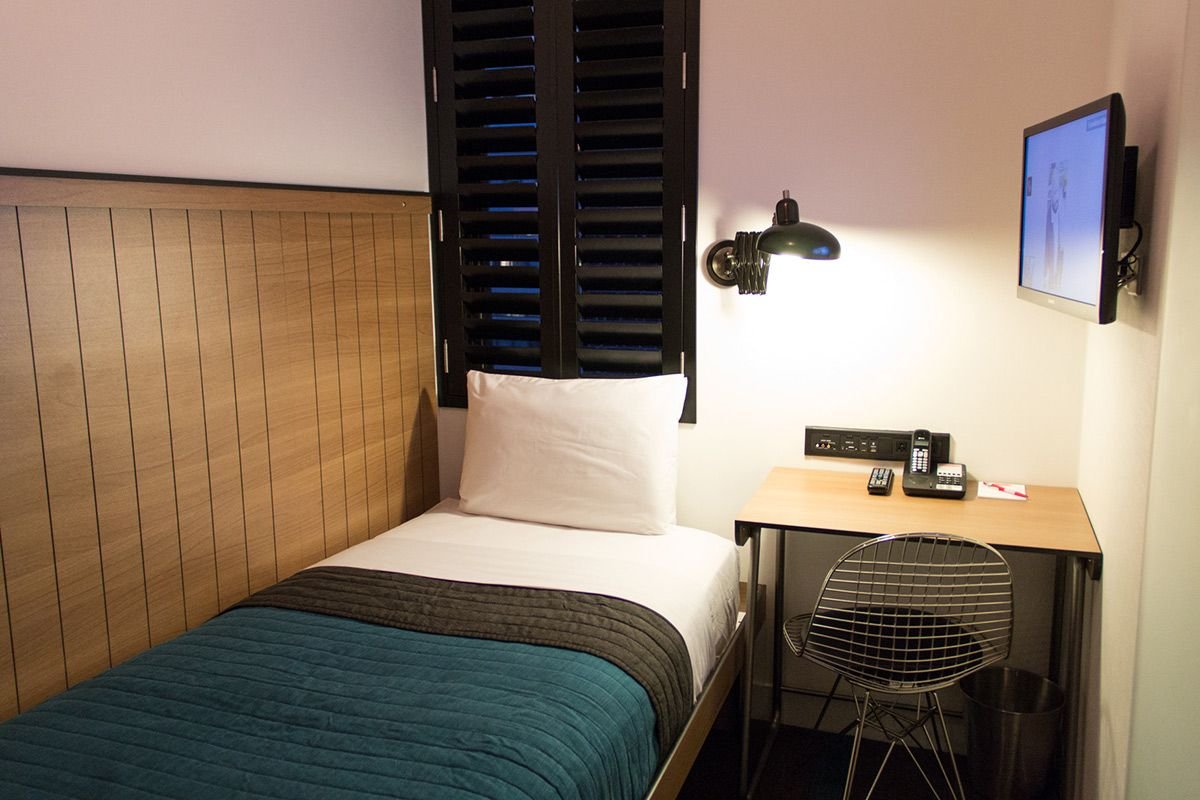
A small hotel room does not need to feel cramped or basic. The right combination of furniture, lighting, storage, colors, and layout can make a compact room feel comfortable while still giving guests the practical features they expect.
The most effective small hotel room design ideas are not simply about making the room look attractive. They solve specific space problems: limited storage, restricted walking areas, insufficient lighting, luggage placement, and the need to fit several functions into one room.
Here are practical ideas that can be adapted to different hotel room layouts and budgets.
1. Place the Bed Against the Most Practical Wall
Start the room design with the bed because it usually occupies the largest amount of floor space.
Position it where guests can access it easily without blocking the entrance, bathroom, wardrobe, or main walking route.
If the room is narrow, placing the bed along the longer wall can sometimes leave a more usable circulation path. The actual dimensions and position of doors and windows should determine the final arrangement.
2. Use a Slim Headboard
A headboard can establish the focal point of the room without requiring a large amount of space.
Instead of a deep, bulky design, consider:
- A slim upholstered panel
- A wall-mounted wooden panel
- Vertical decorative panels
- A simple padded headboard
A wall-mounted design can be particularly useful when every inch of floor space matters.
3. Replace Bulky Nightstands With Floating Shelves
Traditional bedside tables can consume more floor space than necessary.
A floating shelf or compact wall-mounted nightstand can provide enough room for a phone, lamp, glass of water, and other small essentials.
Keeping the floor underneath open can also make the area visually lighter.
4. Build Storage Around the Bed
When floor space is limited, the wall behind or beside the bed can become part of the storage system.
Depending on the layout, you can incorporate:
- Small shelves
- Closed cabinets
- Reading lights
- Charging outlets
- Display niches
This approach reduces the need for separate furniture while keeping frequently used items accessible.
5. Create a Dedicated Luggage Station
Guests need somewhere to put their luggage, and ignoring this requirement can quickly make a small room messy.
A compact luggage bench near the wardrobe or entrance can solve the problem.
For an even more space-conscious design, choose a folding luggage rack or a bench with storage underneath.
6. Choose a Wardrobe With Multiple Functions
Instead of using separate pieces for clothing, mirrors, and storage, combine them where practical.
A compact wardrobe can include:
- Hanging space
- Shelves
- A luggage compartment
- A safe
- A full-length mirror
A mirrored wardrobe door can be particularly useful because it provides a practical feature without requiring another floor-standing mirror.
7. Use a Large Mirror Strategically
A mirror can serve two purposes in a hotel room: it is useful to guests and can create additional visual depth.
A full-length mirror near the wardrobe or entrance is generally more practical than placing a small decorative mirror somewhere difficult to use.
Avoid filling multiple walls with mirrors. One well-positioned mirror is often enough.
8. Install Wall-Mounted Lighting
Bedside lamps placed on small tables can take up valuable surface and floor space.
Wall-mounted reading lights provide illumination while keeping the bedside area clear.
Consider separate lighting for:
- General room illumination
- Reading
- Desk work
- Wardrobe use
- Decorative accents
This gives guests more control over the room’s atmosphere and functionality.
9. Make the Desk Narrow but Useful
A hotel room does not necessarily need a large office desk.
A compact desk can provide enough space for a laptop, notebook, and a few essentials. If possible, choose a design that allows the chair to slide underneath when the workspace is not being used.
The desk should not reduce the main walking route.
10. Use a Chair That Serves More Than One Purpose
A chair can be useful for working, getting dressed, or simply sitting in the room.
Choose a compact design that is comfortable enough for its intended use without overwhelming the space.
If the room includes a desk, the chair should be able to tuck underneath it when not needed.
11. Keep the Window Area Open
Natural light can make a compact room feel more comfortable, so avoid unnecessarily blocking the window.
Position large furniture away from the main window whenever the layout allows.
Use curtains that provide privacy and light control without adding excessive visual weight.
A simple combination of a lighter daytime layer and a heavier privacy layer can work well.
12. Use a Controlled Color Palette
Small hotel rooms generally benefit from visual consistency.
Instead of introducing many unrelated colors, choose a main neutral color and add one or two supporting tones.
For example:
Warm neutral + natural wood + dark accent
or
Soft gray + white + muted green
The objective is not to make everything the same color. It is to prevent too many competing visual elements from making the room feel busy.
13. Add Character With One Feature Wall
A small room does not need decorative treatment on every wall.
The wall behind the bed is often the best place for a feature treatment because it naturally becomes the room’s focal point.
Possible options include:
- Textured wallpaper
- Wood-look panels
- Upholstered panels
- Subtle geometric patterns
- Decorative molding
Keep the remaining walls simpler so the feature wall retains its impact.
14. Use Open Space as Part of the Design
One of the most overlooked small hotel room design ideas is simply leaving enough space empty.
Do not fill every corner with furniture.
Guests need room to:
- Walk around the bed
- Open luggage
- Access the wardrobe
- Sit comfortably
- Move between the entrance and bathroom
A room with fewer but better-positioned pieces can function better than a room packed with furniture.
15. Combine Storage and Seating
If the room has enough space for a bench, choose one that performs multiple functions.
A storage bench can provide:
- Luggage storage
- Seating
- A place to put clothing temporarily
- Additional concealed storage
This is more efficient than adding separate pieces for each function.
16. Use the Space Above Furniture
Vertical space can be valuable when floor space is restricted.
Shelving or shallow cabinets above a desk or storage area can provide additional capacity without extending far into the room.
However, avoid placing too many objects overhead. Storage should remain easy to access and should not make the room feel visually heavy.
17. Keep Technology Integrated
Modern guests commonly need convenient access to charging and electrical outlets.
Rather than adding loose extension cords and chargers across furniture, plan charging points around the room’s main use areas.
Useful locations include:
- Both sides of the bed
- Desk
- Seating area
- Near the luggage/storage zone
Integrating these features during the design stage creates a cleaner result.
18. Use a Simple Material Palette
Too many materials can make a small room feel visually fragmented.
Choose a few complementary materials and repeat them.
For example:
- Wood for furniture
- Upholstery for the headboard
- One metal finish for hardware and lighting
Repeating materials creates cohesion while still allowing texture and contrast.
19. Keep Decorative Accessories Selective
Decorative objects can give a hotel room personality, but excessive accessories can become clutter.
Instead of decorating every surface, choose a few intentional pieces.
A simple arrangement might include:
- One artwork above the desk
- One decorative object on a console
- A small plant or vase
- A restrained bedside accessory
The room should remain easy to clean and practical for guests.
20. Design a Clear Guest Journey
A good hotel room should make sense as soon as the guest enters.
Think about the sequence:
Entrance → luggage/storage → sleeping area → bathroom → workspace/seating
Guests should not have to move furniture or search through the room to understand where things belong.
This is particularly important in compact rooms because poor organization becomes noticeable immediately.
Small Hotel Room Design: What Should You Prioritize?
When space is limited, not every design feature has equal importance.
| Priority | Design element | Why it matters |
|---|---|---|
| 1 | Bed placement | Determines much of the room’s circulation |
| 2 | Walking space | Directly affects comfort and usability |
| 3 | Storage | Prevents luggage and belongings from creating clutter |
| 4 | Lighting | Supports sleeping, reading, working, and atmosphere |
| 5 | Workspace | Useful for guests who need to work |
| 6 | Decorative details | Adds personality after practical needs are solved |
This order helps prevent a common mistake: spending too much space on decoration before solving the basic layout.
Small Hotel Room Layout Example
Consider a narrow rectangular room with the entrance near one end and a window at the opposite end.
A practical arrangement could place the bed along one long wall, with floating bedside shelves on either side. The wardrobe and luggage bench could remain closer to the entrance, while a slim desk could occupy part of the window-side wall.
This creates separate functional zones without requiring large partitions:
Storage zone → sleeping zone → work/light zone
The exact arrangement should always be adjusted according to the actual location of doors, windows, bathroom access, and electrical points.
Common Mistakes in Small Hotel Room Design
Using oversized furniture
Large furniture can quickly reduce the usable walking area.
Designing only for appearance
A beautiful room is not successful if guests cannot easily store luggage, charge devices, or move around.
Adding too many colors
A large variety of colors can make a compact room feel visually fragmented.
Forgetting luggage
Guests need somewhere practical to place their bags.
Blocking natural light
Large furniture positioned carelessly near windows can make the room feel darker.
Overdecorating
Too many accessories increase visual clutter and create additional cleaning requirements.
How to Make a Small Hotel Room Feel More Spacious
You do not necessarily need to remove essential furniture.
Instead:
- Keep the main walking route clear.
- Use furniture proportional to the room.
- Choose wall-mounted elements where practical.
- Keep the color palette coordinated.
- Use one strategically positioned mirror.
- Let natural light reach as much of the room as possible.
- Give luggage a dedicated location.
- Avoid unnecessary decorative objects.
- Use furniture that performs multiple functions.
- Keep the floor visually open where possible.
The goal is not to make the room look empty. It is to make every part of the available space useful.
Final Thoughts
Small hotel room design works best when practicality comes before decoration.
Start with the bed, circulation, storage, luggage, bathroom access, and workspace. Once these elements are working properly, use lighting, materials, color, artwork, and decorative details to establish the hotel’s visual character.
A compact room can feel polished and comfortable when the layout is carefully considered and every major piece has a clear purpose.
Frequently Asked Questions
What is the most important feature in a small hotel room?
The layout is one of the most important considerations because it determines how easily guests can move between the bed, bathroom, storage, entrance, and other areas.
How can I save space in a small hotel room?
Use floating bedside tables, compact desks, multi-purpose furniture, integrated storage, and furniture that uses vertical space without obstructing movement.
What colors work well in a small hotel room?
A coordinated palette of light or medium neutral tones with one or two complementary accents can create a calm and visually consistent interior.
How should furniture be arranged in a small hotel room?
Start with the bed, then establish a clear walking route. Position storage, luggage space, desk, and seating around that circulation path rather than blocking it.
Should a small hotel room have a workspace?
If guests are likely to work during their stay, a compact desk can be useful. It does not need to be large; the priority is providing a practical surface without sacrificing circulation.